
Introduction
Many successful game room businesses start with a simple idea:
Create a great entertainment experience, attract loyal players, and grow the customer base.
At the beginning, managing operations is easy.
The owner knows every player, handles every transaction, and can quickly solve problems.
But as the business grows, the same management methods become a limitation.
When a game room expands from one location to multiple stores, operators face new challenges:
- How do you manage player credits across different locations?
- How do you monitor distributor performance?
- How do you prevent manual errors?
- How do you understand which stores are growing?
This is where a centralized credit system becomes essential.
A centralized system allows game room owners to manage multiple locations, accounts, and transactions through one connected platform.
Instead of controlling every store separately, operators can build a scalable gaming network.
1. What Is A Centralized Credit System?
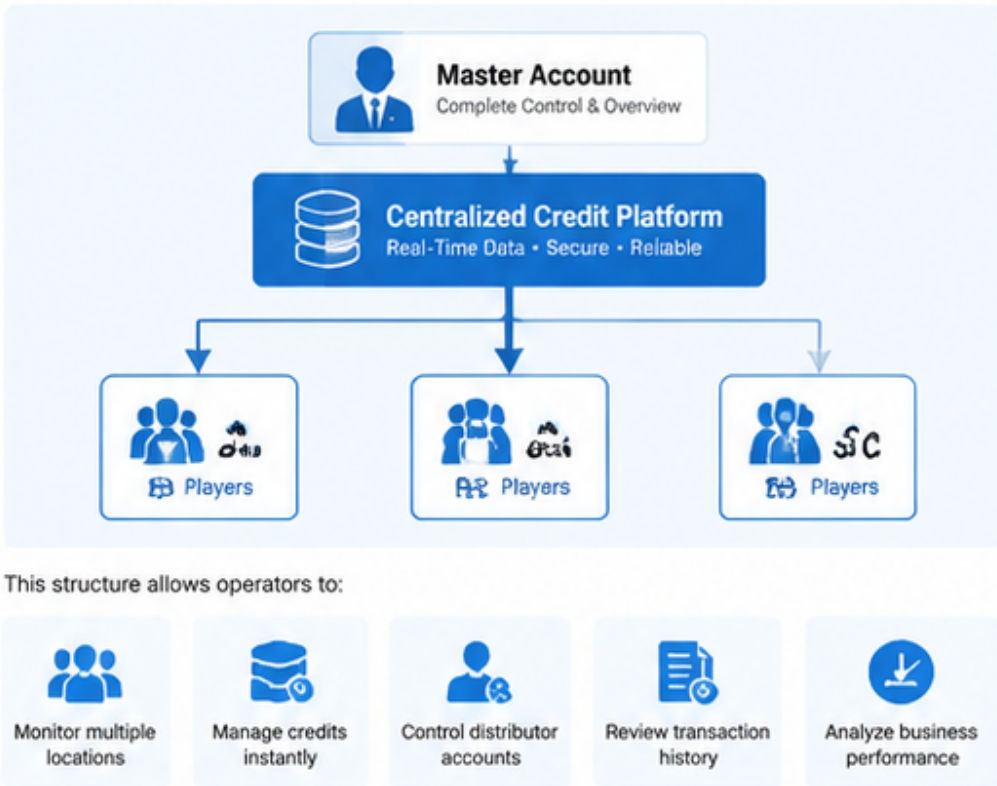
A centralized credit system is a management structure that connects all parts of a gaming business through one platform.
Instead of each store keeping separate records, all account information is managed from a central location.
A typical structure looks like this:
                Master Account

                     ↓

       Centralized Credit Management System

          ↓              ↓              ↓

     Distributor A   Distributor B   Distributor C

          ↓              ↓              ↓

       Store 1        Store 2        Store 3

          ↓              ↓              ↓

       Players       Players        Players
This structure gives operators complete visibility over the entire network.
The owner can manage:
- Player accounts
- Credit balances
- Store performance
- Distributor activity
- Transaction history
2. Why Traditional Credit Management Creates Problems
Many small operators begin with manual methods.
Examples include:
- Spreadsheets
- Messaging apps
- Handwritten records
- Separate databases
While this may work for one location, it becomes difficult when the business expands.
Problem #1: Limited Visibility
With multiple stores, owners often cannot quickly answer:
- Which location has the most active players?
- Which distributor is performing best?
- How much credit is being used daily?
- Where are problems happening?
Without accurate data, business decisions become based on assumptions.
Problem #2: Human Errors
Manual systems create risks:
- Incorrect balances
- Duplicate records
- Missing transactions
- Delayed updates
Even small mistakes can affect customer trust.
Players expect accurate and instant account information.
Problem #3: Difficult Expansion
A business that depends on manual management is difficult to scale.
Opening a second location means:
- More employees
- More records
- More monitoring
- More communication
Without a centralized system, every additional location increases complexity.
3. How Centralized Systems Help Operators Scale
A centralized credit system changes the way operators grow.
Instead of adding more management problems with every new store, the system creates a repeatable structure.
Benefit 1: Manage Multiple Locations From One Dashboard
The biggest advantage is centralized control.
Owners can monitor:
- Multiple stores
- Distributor accounts
- Player activity
- Credit movement
Example:
A business owner operates 10 locations.
Without a centralized system:
Store A → Separate records

Store B → Separate records

Store C → Separate records

Store D → Separate records
The owner must collect information manually.
With a centralized system:
             One Dashboard

                  ↓

Store A | Store B | Store C | Store D
All information is available in one place.
Benefit 2: Better Distributor Management
Many gaming businesses grow through distributor networks.
A distributor helps operators:
- Expand into new markets
- Support local stores
- Manage customers
- Build relationships
However, managing distributors manually can become complicated.
A centralized system allows owners to create different permission levels.
Example:
Master Account

     ↓

Regional Distributor

     ↓

Local Store Operator

     ↓

Players
Each level has specific responsibilities.
This makes expansion easier and more organized.
Benefit 3: Real-Time Credit Control
Credit management is one of the most important parts of a gaming business.
Operators need to know:
- Current balances
- Credit distribution
- Transaction history
- Account activity
A centralized platform provides real-time updates.
This helps:
- Reduce mistakes
- Improve customer service
- Increase operational efficiency
Benefit 4: Improve Player Experience
Players do not see the backend system.
But they experience the results.
A good management system creates:
Faster Service
Players receive faster account support.
More Reliable Transactions
Accurate balances create trust.
Better Promotions
Operators can analyze player activity and design better engagement strategies.
4. Data Helps Game Room Owners Make Better Decisions
Modern gaming businesses are built on information.
A centralized platform allows operators to analyze:
Player Activity
Understand:
- Active users
- Popular games
- Playing patterns
Store Performance
Compare:
- Location performance
- Growth trends
- Customer activity
Business Optimization
Data helps answer important questions:
- Which games attract more players?
- Which locations need support?
- Which promotions work best?
Successful operators use data instead of guessing.
5. Centralized Systems Make Expansion Easier
Growing from one location to multiple locations requires a repeatable business model.
A centralized system provides the foundation.
The expansion process becomes:
Step 1: Build The First Successful Location
Create:
- Good player experience
- Stable operations
- Reliable processes
Step 2: Add Distributor Partners
Expand through trusted partners.
Step 3: Connect New Locations
Every new store joins the same management system.
Step 4: Monitor And Optimize
Use data to improve performance.
This approach allows businesses to grow without losing control.
6. Features Operators Should Look For In A Credit Management System
A professional gaming platform should include:
Multi-Level Account Management
Support:
- Master accounts
- Distributors
- Store operators
- Players
Transaction History
Operators should be able to review:
- Credit changes
- Account activity
- Usage records
Real-Time Reporting
Important reports include:
- Player statistics
- Store performance
- Revenue analysis
Scalable Architecture
The system should support growth from:
- One location
- Multiple stores
- Large networks
7. The Future Of Game Room Operations
The gaming industry is becoming more technology-driven.
Future operators will rely less on manual processes and more on:
- Automated management systems
- Cloud platforms
- Real-time analytics
- Centralized operations
The difference between a small operator and a large gaming network is not only the number of locations.
It is the technology behind the business.
Conclusion
A centralized credit system is no longer just a convenience.
For growing game room businesses, it is the foundation for expansion.
By connecting players, stores, distributors, and management teams through one platform, operators can:
- Reduce operational problems
- Improve control
- Make better decisions
- Scale faster
Businesses that invest in efficient systems today will have stronger advantages as the gaming market continues to grow.
Frequently Asked Questions (FAQ)
What is a centralized credit system?
A centralized credit system is a platform that allows gaming operators to manage accounts, credits, transactions, and locations from one central system.
Why do game room businesses need centralized management?
Because managing multiple locations manually creates problems with accuracy, monitoring, and expansion.
Can a centralized system manage multiple stores?
Yes. Professional gaming management platforms are designed to support multiple locations and distributor networks.
How does centralized credit management improve operations?
It improves accuracy, provides real-time data, reduces manual work, and gives owners better control.
Is centralized management suitable for small operators?
Yes. Many successful businesses start with one location and use centralized systems to prepare for future growth.
CTA
Build a stronger gaming network with smarter management.
CashMaster Agent helps game room operators simplify account management, organize distributor networks, and create scalable gaming operations.
Contact our team to learn how modern operators build their business infrastructure.