
Introduction
Starting a game room business is often simple at the beginning.
Many successful operators start with a single location, a small group of players, and a basic management process. The owner knows every customer, tracks credits manually, and handles daily operations personally.
However, as the business grows, problems begin to appear.
Managing multiple locations, controlling player balances, supporting employees, and maintaining accurate financial records become much more difficult.
The biggest difference between a small game room and a professional gaming network is not only the number of locations.
It is the management system behind the business.
Successful operators use centralized technology, structured credit management, and organized distributor networks to expand efficiently.
This guide explains how game room owners can move from one store to a scalable multi-location operation.
1. The Challenge Of Growing From One Game Room To Multiple Locations
A single location is relatively easy to manage.
The owner can personally monitor:
- Player activity
- Credit transactions
- Employee performance
- Daily revenue
- Customer relationships
But when expanding to multiple stores, traditional management methods quickly become inefficient.
Common problems include:
Manual Credit Tracking
Many small operators rely on:
- Spreadsheets
- Messages
- Paper records
- Individual employee reports
This creates risks:
- Incorrect balances
- Human mistakes
- Difficult auditing
- Slow updates
A growing business needs a centralized system where all credit activity can be monitored in real time.
Employee Management Issues
When you have one store, the owner can supervise everything.
When you have five or ten locations, you need:
- Store managers
- Regional distributors
- Customer support staff
- Financial controls
Without proper systems, owners lose visibility.
Player Retention Problems
Players expect:
- Fast service
- Accurate balances
- Reliable transactions
- Multiple game choices
A professional platform helps operators provide a consistent experience across every location.
2. Why Centralized Credit Management Is Important
A centralized credit system is one of the most important tools for scaling a gaming network.
Instead of every location operating independently, all stores connect through one management platform.
Example:
                 Master Account

                       |

          Centralized Credit Platform

        /              |              \

   Store A          Store B          Store C

     |                |                |

 Players          Players          Players
This structure allows operators to:
- Monitor multiple locations
- Manage credits instantly
- Control distributor accounts
- Review transaction history
- Analyze business performance
3. Building A Professional Game Room Network Structure
A scalable operation usually has several levels.
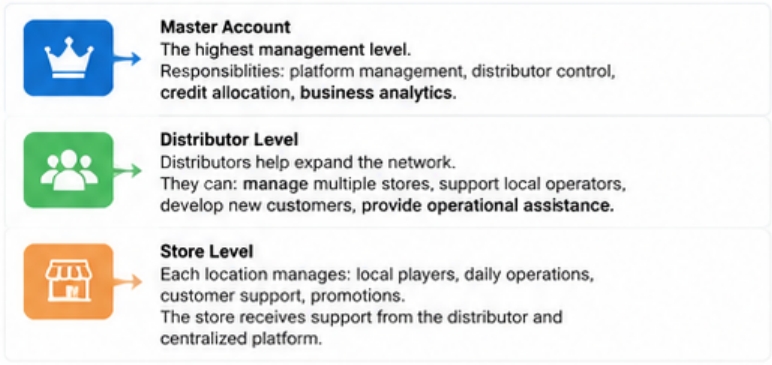
Master Account
The highest management level.
Responsibilities:
- Platform management
- Distributor control
- Credit allocation
- Business analytics
Distributor Level
Distributors help expand the network.
They can:
- Manage multiple stores
- Support local operators
- Develop new customers
- Provide operational assistance
A strong distributor network allows businesses to grow faster without requiring the owner to manage every location personally.
Store Level
Each location manages:
- Local players
- Daily operations
- Customer support
- Promotions
The store receives support from the distributor and centralized platform.
4. The Importance Of A Reliable Game Platform
A game room business is not only about having games.
The platform experience directly affects customer retention.
Operators should consider:
Game Variety
Players enjoy different experiences:
- Slot games
- Fishing games
- Keno
- Arcade-style games
- Bonus games
More variety helps operators attract different player groups.
Stable Performance
Players expect:
- Fast loading
- Smooth gameplay
- Reliable connections
Technical problems can quickly reduce customer trust.
Easy Account Management
A professional system should simplify:
- Player registration
- Credit management
- Transaction history
- Account monitoring
The easier the system is to operate, the easier it is to scale.
5. How Successful Operators Expand Their Network
Growing a game room business requires more than opening new locations.
Successful operators focus on building a repeatable system.
Step 1: Create A Standard Operating Process
Before expansion, define:
- Store procedures
- Employee responsibilities
- Customer support methods
- Credit rules
A business cannot scale if everything depends on the owner.
Step 2: Develop Distributor Partnerships
Distributors can become growth partners.
A strong distributor helps:
- Find new locations
- Train operators
- Support customers
- Expand market reach
Step 3: Use Data To Make Decisions
A modern gaming business should track:
- Active players
- Popular games
- Transaction volume
- Store performance
Data helps owners understand what works and where improvements are needed.
6. Common Mistakes When Expanding A Game Room Business
Mistake #1: Growing Too Quickly Without Systems
Opening multiple locations without proper management creates chaos.
Growth should follow system development.
Mistake #2: Depending Only On Employees
Employees change.
Systems remain.
A professional platform reduces dependence on individual workers.
Mistake #3: Ignoring Player Experience
The most successful operators focus on customers.
Important factors include:
- Fast service
- Reliable balances
- Good game selection
- Regular engagement
7. The Future Of Game Room Businesses
The gaming industry continues moving toward digital management.
Traditional manual operations are being replaced by:
- Cloud-based management systems
- Automated reporting
- Centralized accounts
- Multi-location platforms
The operators who adapt faster will have stronger advantages.
A small store can become a large network when supported by the right technology and business structure.
Conclusion
Scaling a game room business from one location to multiple stores requires more than additional customers.
The foundation of long-term growth is:
- Centralized credit management
- Reliable gaming technology
- Distributor networks
- Standardized operations
Operators who build strong systems can expand faster, manage more locations, and create a sustainable gaming network.
Frequently Asked Questions (FAQ)
What is a game room business?
A game room business provides customers with access to digital entertainment games through a managed gaming platform.
How can I scale my game room business?
The best way to scale is by creating standardized operations, using centralized management tools, and building distributor partnerships.
Why is a centralized credit system important?
A centralized credit system helps operators manage multiple locations, track transactions, and maintain accurate account information.
Can one platform manage multiple game room locations?
Yes. Professional gaming management platforms are designed to support multiple stores, distributors, and player accounts.
What makes a successful game room operator?
Successful operators focus on system management, customer experience, technology, and network growth.
CTA
Ready to build a scalable gaming network?
A professional gaming platform can help operators manage stores, distributors, and players through one centralized system.
Contact CashMaster Agent to learn how modern game room operators build and grow their networks.